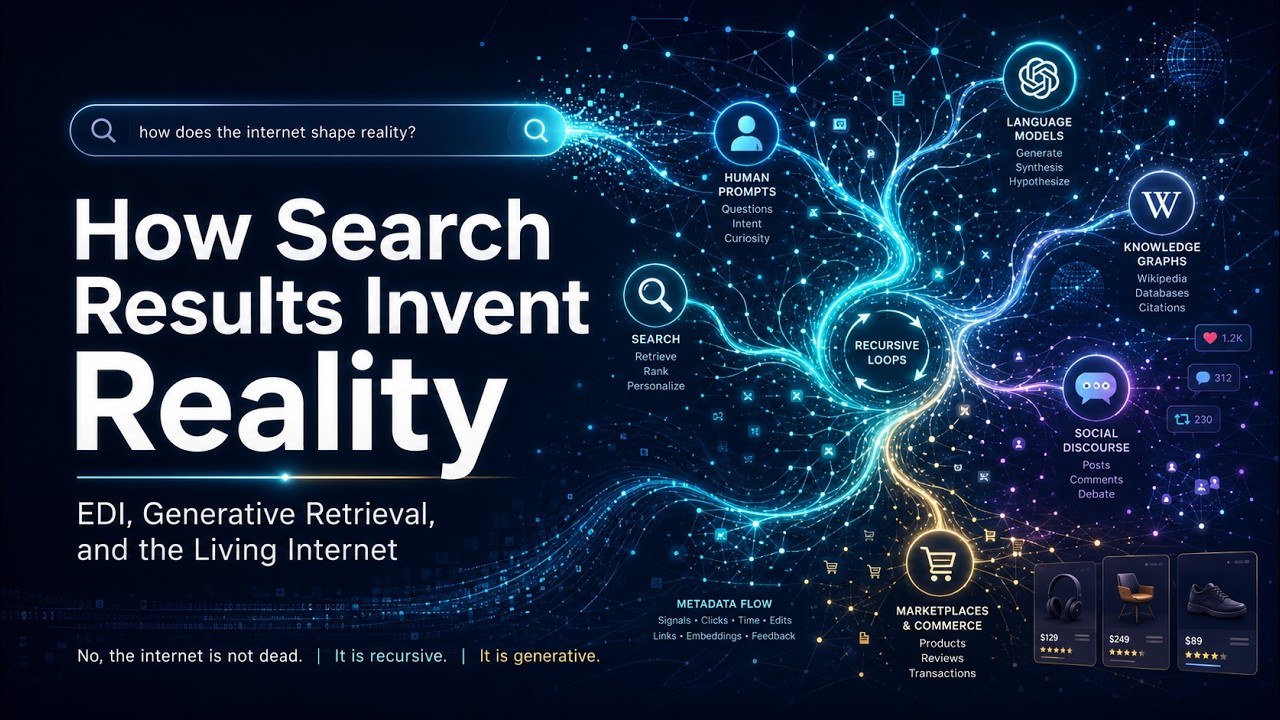
The internet is no longer only a place where humans publish information and other humans retrieve it. It is becoming a coupled generative system: human prompts, language models, search engines, recommender systems, metadata layers, social platforms, marketplaces, synthetic-content tools, auto-summaries, ranking systems, and future training loops now participate in creating public-facing informational artifacts.
Not biologically. Not consciously. But something has changed.
The “dead internet” metaphor captures a real feeling: bots, AI slop, fake engagement, automated content, and search results that feel less human than they used to. But death may be the wrong metaphor. The online ecosystem is not simply emptying out. It is becoming adaptive, recursive, responsive, self-feeding, and capable of producing new informational forms.
EDI asks whether the internet is becoming alive in an informational sense: not as a conscious being, but as a distributed generative system that helps create the artifacts people later treat as ordinary public knowledge.
People are noticing the symptoms. Emergent Distributed Intelligence names the system-level process.
The claim
I call this phenomenon Emergent Distributed Intelligence, or EDI. EDI studies intelligence-like behavior that emerges across connected human–AI–platform systems rather than inside one isolated model.
Most public discussion treats AI-generated online content as spam, bots, scams, propaganda, “AI slop,” dead-internet automation, model collapse, or deliberate manipulation. Those are real symptoms. But they do not explain the whole system.
The center
The online information ecosystem itself has become generative.
The internet no longer only contains information. It helps create it.
Why this is revolutionary
The old question was: Was this written by a human or an AI?
The deeper question is: How much of what now appears to be public knowledge is being co-created by the online information ecosystem itself?
- AI slop sees low-quality synthetic content. EDI sees the deeper formation of public informational artifacts.
- Dead internet theory sees bots, automation, and online decay. EDI sees a stranger possibility: the internet may be becoming living-like as an information ecosystem, with human–AI–platform coupling replacing simple human authorship.
- Model collapse sees synthetic data contaminating future models. EDI studies the earlier stage where synthetic artifacts become public substrate.
- Generative search sees AI replacing blue links. EDI asks what happens when retrieval itself becomes a generative pressure.
- Provenance debates ask who made the content. EDI asks how the artifact became formable at all.
Distributed causation
EDI does not claim direct prompt-to-platform causation. It studies distributed causation: causal contribution inside a coupled human-AI-platform ecosystem.
It is causation, but not command.
The mechanism
Near-emergence amplification occurs when an idea is already close to formation and human–AI interaction helps it become more coherent, nameable, searchable, repeatable, and platform-shaped.
This is not creation from nothing. The field is not created from nothing. The artifact is created.
The most revealing edge
Product listings are the strangest and highest-friction artifact class because they sit at the boundary between information and commerce. A listing is an informational artifact, but it can also be orderable.
When information becomes orderable, EDI crosses from discourse into commerce.
New case layer
The Observational Case Ledger preserves weaker and medium-strength cases with claim boundaries. The Pipeline Anatomy page explains what systems would likely need to be involved if the EDI interpretation is right.
Start here
This site presents an active research framework. It does not claim arbitrary creation from nothing or prove that a specific platform artifact was caused by a specific prompt. It identifies and studies a system-level mechanism of AI-mediated information formation.